You've prepared your presentation, delivered your message, and reached your final slide. Now you ask, "Any questions?"
Silence.
Or perhaps one person takes over the conversation, someone raises an unrelated issue, or the discussion gets so detailed that you lose sight of your original purpose.
Sound familiar?
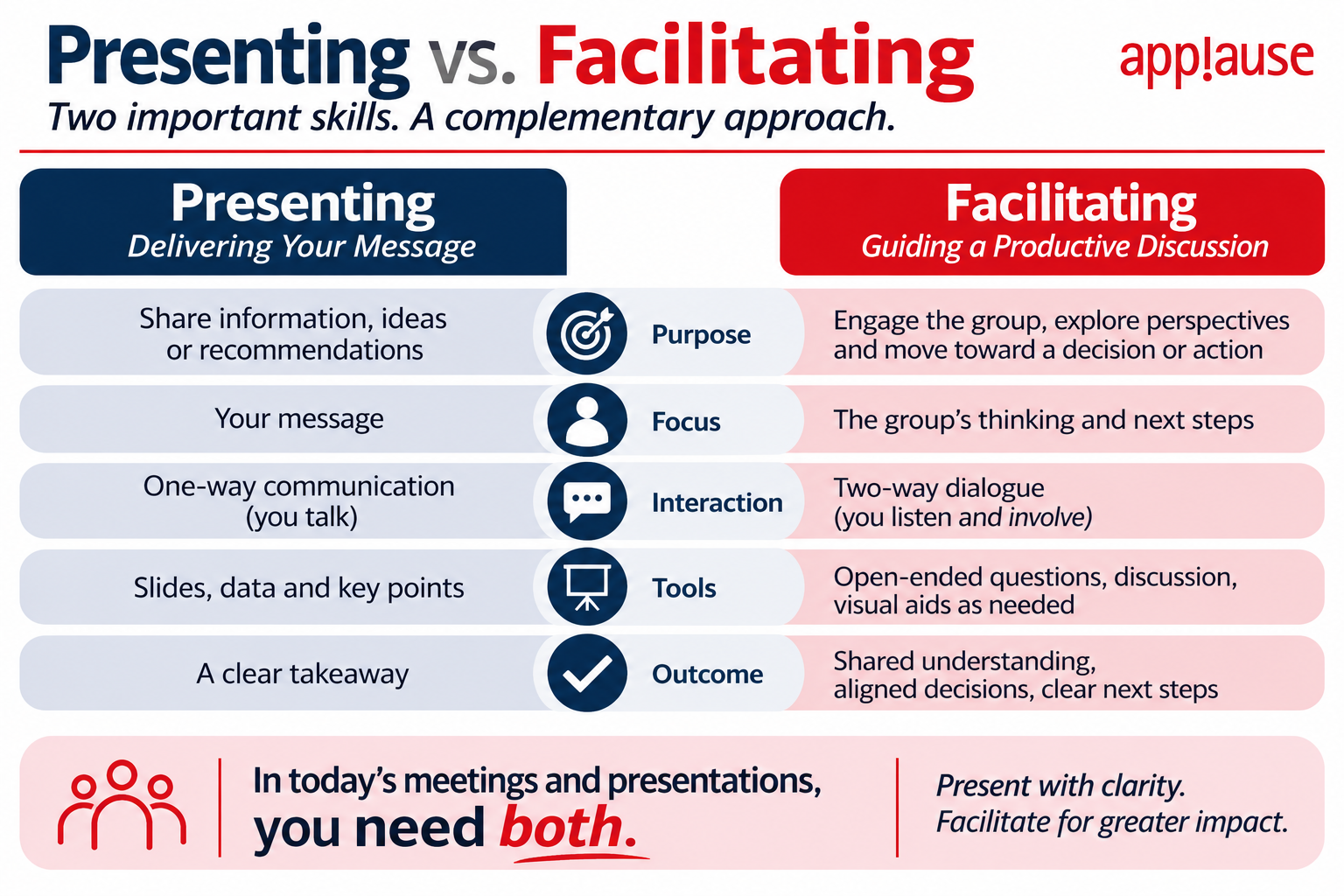
Giving a presentation and leading a discussion require different skills. A good presenter communicates information clearly. An effective facilitator helps people engage with that information, share perspectives, work through questions, and determine what happens next.
The good news? You can learn to do both.
5 Ways to Lead a More Productive Discussion
1. Don't rely on "Any questions?"
It's an easy way to end a presentation, but it doesn't always encourage participation. Instead, ask a more specific, open-ended question.
Try:
"What questions or concerns do you have?"
"What stands out to you?"
"How might this affect your team?"
"What challenges do you see?"
Specific questions give people something to respond to.
2. Make it easy for people to participate.
Not everyone is comfortable speaking up in a group. Give people a moment to think before asking for responses. If the group is large, invite people to share with a partner first.
And don't be afraid of silence. Give people time to formulate their thoughts rather than answering your own question.
3. Keep the discussion on track.
Sometimes a question leads the conversation in a direction that isn't relevant to your purpose. Acknowledge the comment, then redirect.
For example:
"I can see why that's important. Let's capture it as a separate issue and come back to it. For now, I'd like to focus on..."
You can keep the discussion productive without dismissing someone's contribution.
4. Encourage different perspectives.
If one person dominates the conversation, invite others to contribute.
Try:
"I'd like to hear from someone who hasn't weighed in yet."
"Does anyone see this differently?"
"What might we be overlooking?"
Your role isn't to have all the answers. It's to create an environment where useful ideas can surface.
5. End with a clear next step.
A lively discussion isn't necessarily a productive one. Before wrapping up, summarize the key points, clarify any decisions, and identify next steps.
Ask:
What have we agreed on?
What questions still need to be answered?
Who is responsible for what?
What happens next?
Make sure everyone leaves with a shared understanding.
Being an effective presenter is about more than delivering information. It's also about engaging your audience, responding to questions, managing different perspectives, and guiding a conversation toward a useful outcome.
These are facilitation skills—and they're just as important in everyday meetings, project discussions, and team decision-making as they are in formal presentations.
At Applause, we help professionals develop both sides of effective communication. Our Presenting with Confidence and Creating Strategic Presentations workshops provide skill building, hands-on application, practice, feedback and reinforcement of new skills. We help people organize and deliver clear messages, engage their audiences, handle questions and interruptions, and lead more productive discussions.
Because the goal isn't simply to give a good presentation.
It's to make something useful happen as a result of it.